2026-10-01 · Tom Harlan
Closed Cell vs Open Cell Spray Foam for Tulsa Attics, Pole Barns and Shops
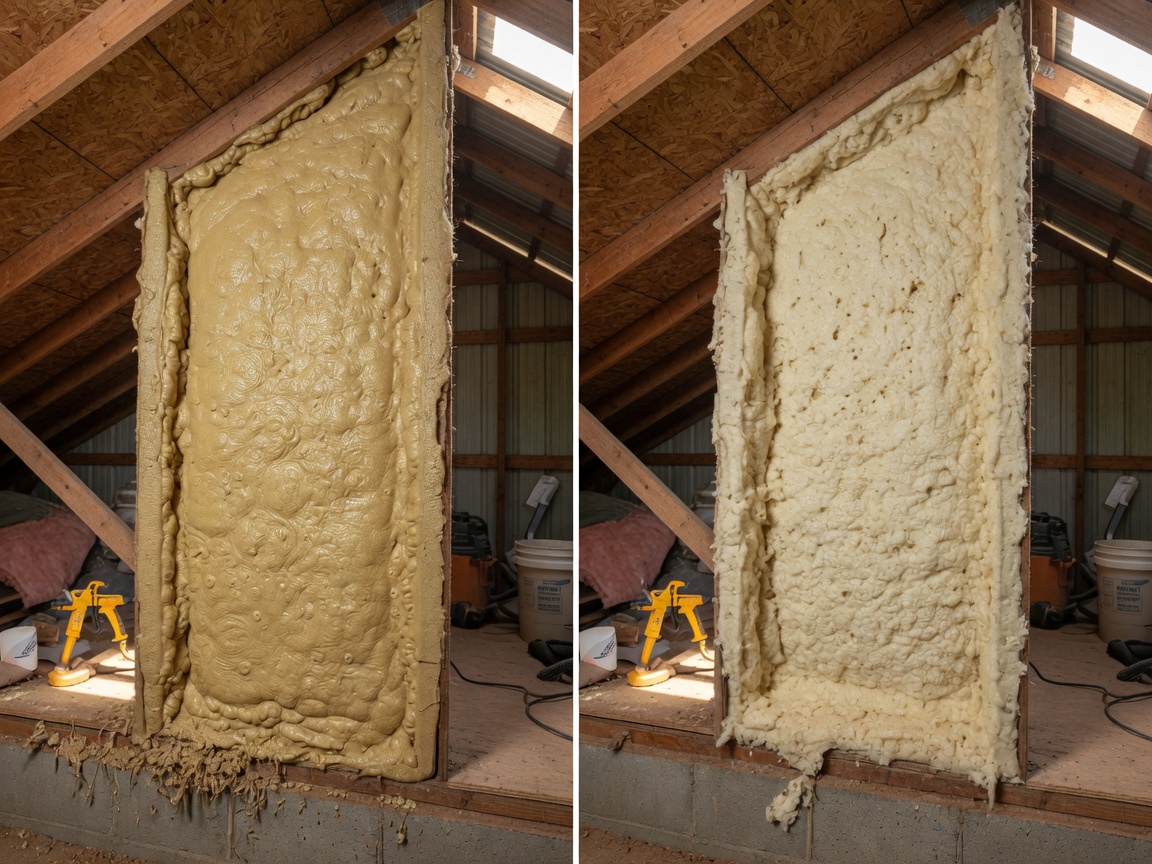
For Tulsa attics, closed cell spray foam usually outperforms open cell because it blocks moisture from frequent severe thunderstorms and provides structural rigidity in older homes across Maple Ridge and the Pearl District. Open cell spray foam suits pole barns and shops in Jenks or Bixby where airflow helps manage humidity without trapping vapor. Both options handle Tulsa County's warm humid summers and cold winters, but selection depends on roof deck condition, existing ventilation and whether the space stays conditioned.
Closed Cell Spray Foam Performance
Closed cell spray foam forms a rigid, closed structure that resists water absorption during Tulsa's heavy spring storms. It adds shear strength to roof decks common in 1950s-1970s homes found in Cherry Street and Utica Square. In attics, this type typically achieves R-6.5 to R-7 per inch, allowing thinner applications while meeting Oklahoma energy codes. The material also limits air leakage around penetrations, which matters when summer humidity pushes moisture into unconditioned spaces. Installers often apply it directly to the roof deck in unvented attics to prevent condensation on cold winter nights. Because it expands minimally, closed cell works well in tight cavities without disturbing wiring or light fixtures.
Open Cell Spray Foam Characteristics
Open cell spray foam expands to fill irregular spaces and stays flexible after curing, making it suitable for pole barns and shops with metal roofing that expands and contracts. It provides R-3.6 to R-4 per inch and allows vapor to pass, reducing trapped moisture in buildings that see wide temperature swings between Tulsa summers and winters. Crews often use open cell in attics where existing fiberglass must stay in place or where cost per board foot matters more than maximum R-value. The softer texture does not add structural strength, so builders in Owasso and Broken Arrow prefer it for non-load-bearing walls in shops. Open cell also absorbs sound, which helps in metal buildings near the BOK Center or Cain's Ballroom area.
Attic Applications in Tulsa Homes
Tulsa attics in neighborhoods like Greenwood and Downtown Tulsa frequently contain knob-and-tube wiring or shallow joist bays that limit insulation depth. Closed cell spray foam seals these areas without compressing existing material and handles the thermal bridging common in older rafters. Homeowners in Brookside often choose closed cell when converting attics to bonus rooms because it prevents humid air from reaching the roof deck during July thunderstorms. Open cell remains an option when the attic stays vented and the goal is simply to reduce summer heat gain. Both types require proper surface prep to remove dust from decades of use. See the guide on Should You Spray Foam Your Attic Roof? for venting details specific to Oklahoma homes.
Pole Barns and Shops in Surrounding Cities
Pole barns and shops in Bixby, Jenks and Owasso often feature exposed metal panels that sweat during humid summer nights. Open cell spray foam applied to the underside of the roof allows drying while still cutting energy loss in winter. Closed cell works better when the building stores equipment sensitive to moisture or when the owner wants added rigidity against high winds. In these structures, crews typically spray 2-3 inches of either product on walls and 4-6 inches on ceilings to balance cost and performance. The address at 4343 S Memorial Dr, Tulsa, OK 74145 serves as the base for crews traveling to these sites. Shop owners near the Tulsa Air and Space Museum or Route 66 Historical Village report lower heating bills after open cell installation because the material fills gaps around girts without adding weight to the trusses.
Climate and Local Building Factors
Tulsa County's mix of clay soils and frequent temperature swings affects how insulation performs over time. Closed cell resists water vapor drive during prolonged humidity, protecting attics in Maple Ridge homes built before modern vapor barriers. Open cell performs adequately in pole barns where ridge vents and eave gaps already manage airflow. Severe thunderstorms can drive rain under flashing; closed cell creates an additional drainage plane on roof decks. Crews schedule work between 8am-6pm weekdays and 9am-2pm Saturdays to avoid peak heat and afternoon storms. For deeper R-value comparisons, review How Much Attic Insulation Do Tulsa Homes Need?.